
The biggest names in gaming, sports, music, and the creator economy are all making the same bet. Show up with enough force and the world has to pause. Rockstar just confirmed what we already suspected about GTA 6. Kai Cenat shut down another city block, continuing to prove that creator gravity is real. The music industry is in a full-on war with AI companies over who owns the future of sound. And influencer marketing just crossed a structural threshold that should change how every brand team is building its creator strategy.
Today: the game release that is rewriting the competitive calendar for every studio, the creator-economy number that should recalibrate your budget conversation, and the distribution play that proves creators are the new broadcast networks.

BRING RECEIPTS
Kai Cenat demonstrated (again) that a single creator can move a city.
Thousands packed the area outside State Farm Arena in Atlanta, GA on June 17th as aspiring content creators/streamers lined up for a shot at being included in Streamer University 2.
The event was moved to State Farm Arena after earlier gatherings led to overcrowding, disruptions, and seven arrests.
The audition tour had already run through New York and Los Angeles before landing in Atlanta. The infrastructure Cenat is building here matters beyond the spectacle. Streamer University is designed to connect aspiring creators with experienced streamers through workshops, networking, and collaborative content, structured across three categories: student, professor, and club director.
Selected attendees participate free of charge, with accommodations and meals covered. This is creator institution-building. No brand in the world is generating this kind of earned media, this kind of physical mobilization, or this kind of aspirational loyalty with its own talent programs. Receipt: FOX 5 Atlanta / Complex
Influencer marketing just crossed a structural threshold, and the deal model that brands have relied on for a decade is on the way out.
Influencer marketing has crossed a structural threshold in 2026. The U.S. influencer economy is on track to reach $44 billion this year, up 18% from $37.1 billion in 2025, but the headline number masks a more significant shift: the way brands pay creators is being fundamentally rewritten, moving from one-off transactional deals to long-term performance-based partnerships that tie compensation directly to measurable outcomes.
Performance-based compensation now accounts for 53% of creator partnerships, up from 23% two years ago, as brands demand measurable ROI. The era of the flat-fee Instagram post as a complete campaign strategy is over. Long-term creator partnerships deliver 70% higher engagement than one-off collaborations, according to analysis by Archive App. The teams moving budget into retained creator relationships right now are building a structural advantage over everyone still running one-off activations. Receipt: ECIKS
The music industry's AI reckoning is no longer about whether AI belongs in music. It is about who controls the terms.
AI music licensing is no longer a theoretical debate. By 2026, Universal Music Group, Sony Music, and Warner Music Group have each entered licensing agreements with generative music platforms.
The problem: the artists and songwriters whose works, voices, performances, likenesses, and creative identities make those deals valuable are not being meaningfully consulted, and they remain the primary holders of many of the rights at stake. Artist managers and music manager forums globally have responded with an open letter demanding "no default opt-ins, no forced AI clauses and no use of artists' work, voice, performance, likeness or creative identity without meaningful consent, fair remuneration and full transparency."
Talent lawyer Avi Dahan describes the current dealmaking landscape as the "Wild West," a transition period where it's becoming common practice for labels to require disclosure of AI used to create a recording, but only some are asserting rights to use music for AI training of their own. The frameworks being set right now will determine creator leverage in music for the next decade. Watch this closely. Receipt: Billboard

LOCK IN
Ever since GTA 6 got a release date, the rest of the industry got out of the way.
In a street interview by TikTok account @TheSchoolofHardKnocks, Take-Two CEO Strauss Zelnick re-confirmed November 19, 2026 as the official release date for Grand Theft Auto VI, and the response from the gaming world was immediate and absolute. The cover art dropped. Vice City looks extraordinary in new images. Pre-orders go live on Thursday. And the meme production and conversation around GTA 6 hasn't slowed down. But the biggest game in a generation is also the one most brand teams are quietly afraid to touch. That tension is part of the real story here.
This is the gravitational pull that only one or two games per generation ever achieve. GTA 6 isn't exactly competing for your attention the way most other titles do. No, instead, the entire competitive landscape reorganizes around it. Publishers aren't stupid; Kotaku has noted that the gaming release window around GTA 6's launch has become conspicuously clear, with no other major titles wanting to land anywhere near November 19.
What's happening here goes far deeper than release-date strategy. The cover art reveal alone became a cultural event. Rockstar has maintained a specific visual tradition across 25 years of covers, and the GTA 6 art honored that lineage while generating its own wave of analysis, meme content, and obsessive fan scrutiny. The Ferris wheel in Vice City's new footage has fans cataloguing whether its reflection is accurate to real-world physics. This is the kind of irrational audience investment that no marketing budget manufactures. It's truly the product of earned cultural trust, built over decades and paid back at launch with interest.
For brands and marketers, the GTA 6 window deserves the same respect the gaming industry is giving it. But it comes with an elephant that has to be named. Grand Theft Auto is M-rated by design: extreme violence, drugs, adult themes, and a satirical worldview built to skewer corporate America. By conventional brand-safety standards, the game is radioactive, and Rockstar has famously kept real brands out of its world anyway, filling it with parodies that exist to mock them. No in-game ad space, no integrations. So most teams will land on the safe conclusion: too risky, sit it out.
That's a category error. The opportunity was never to put a logo inside Vice City. It's the cultural gravity around the launch, and that gravity is overwhelmingly brand-safe. The game is M-rated but the conversation around it is just culture. For a few categories (regulated finance, kids' brands, anything that can't sit within arm's length of the content) this genuinely isn't the moment, and that's an obvious call. For everyone else, the hesitation is mostly reflex, and it's exactly how brands talk themselves out of the biggest attention event of the cycle.
The audience that stops everything for GTA 6 isn't a niche. It's the core 18-to-34 demographic, globally, that every brand claims to want. They'll be playing, streaming, watching, and talking about nothing else for weeks. The creator layer will be massive: every major gaming-adjacent channel will be in it, reaction content will flood TikTok and YouTube, and the game's world (a stylized, satirical version of Miami) will generate its own set of references that will migrate into broader culture fast. Not to mention the swaths of UGC we're expecting to see on day 1, coming off the back of Rockstar's acquisition of Cfx.re and, subsequently, FiveM and RedM which hosts massive communities spanning roleplay servers and other mod servers.
The non-obvious play here is in the weeks before launch. The GTA 6 hype cycle is already at full volume. Brands that want adjacency to this moment need to have moved already or start moving now. Long-tail integration during the pre-launch period, creator content aligned with the game's aesthetic, and campaign timing that catches the community in peak anticipation mode are all more efficient entry points than trying to compete for attention post-launch when the flood of content drowns out everything that's not organic. The games that try to share oxygen with GTA 6 in November are going to see some struggles. The brands smart enough to ride the pre-launch wave instead of the post-launch noise will get the better return.
The Rockstar endgame for GTA 6 has been years in the making. The release date confirmation isn't the beginning of the sprint but more like the final few hundred meters of this drawn-out marathon. The audience has been ready. The calendar is clear. And any brand that yet to figure out what role it plays in that moment is already behind.
The audience that stops everything for GTA 6 isn't a niche. It's the core 18-to-34 demographic, globally, that every brand claims to want.

DON'T SLEEP
iShowSpeed just locked in the World Cup. But the bigger story is what it means when creators become the primary broadcast.
Most people reading this already know who Speed is. The point is in the model, not the creator or the name. iShowSpeed has secured a deal to co-stream the FIFA World Cup matches on YouTube, including the final, giving him official access to broadcast feeds and distribution rights for the tournament's biggest games. Speed isn't a passive sponsor in this case, as I covered in a previous issue, he's a genuine football (soccer) fanatic with a rabidly engaged, genuinely global audience who watches him react to matches the same way a previous generation watched SportsCenter. The pure authenticity is the product.
The pattern worth tracking is that creators are no longer just supplementing official broadcasts, instead they're becoming the primary distribution layer for live cultural events for large segments of the audience in entirely new ways, reaching viewers who otherwise wouldn't simply tune in. Speed's World Cup streams will pull viewership numbers that rival, and in some demographics, surpass traditional broadcast coverage in certain markets. For brands, the implication is direct: the rights conversation is shifting. Partnering with a creator who holds co-streaming rights to a tentpole event is now, functionally, a media buy with a culture premium attached (and, in some cases, much more accessible than a direct integration). The teams that recognize this before it becomes blanketed consensus will find much better pricing and much more authentic integration than the ones who show up after the pattern is too obvious.
THE SIGNAL
THE NUMBER: $310 Billion
The projected market size of the influencer marketing industry in 2026, on a trajectory toward $1.3 trillion by 2033, with North America accounting for more than one-third of total market size.
Receipt: PRNewswire / Grand View Research
The number is striking, but the real signal is in the structure of how that money is being deployed. US creator ad spend is projected to reach $43.9 billion in 2026, up 18% from $37.1 billion in 2025. Performance-based compensation adoption hit 53% in 2026, more than double the 23% adoption rate just two years ago, and 74% of marketers plan to increase their influencer marketing budgets. This is a wholesale restructuring of where brand dollars go and how accountability is structured around them.
The brands winning in this environment aren't the ones spending the most. Micro-influencers deliver 60% higher engagement at one-tenth the cost, with long-term partnerships yielding 3.5x to 5.5x return on ad spend in 2026. The calculus is rather clear: depth of fit beats width of reach. A creator with 80,000 followers who has been talking about your category for two years and has genuine audience trust is a fundamentally different asset than a celebrity-influencer with millions of followers and a sponsored post cadence that creates noise and their audience just scrolls past.
According to the IAB's 2025 Creator Economy Ad Spend & Strategy Report, creator advertising is growing four times faster than the broader media industry. Brands are actively reallocating budgets from legacy channels: 60% of brand leaders are cutting print advertising investment while 50% are reducing linear TV spend, redirecting those dollars toward creator-driven strategies.
Where this is heading: the brands building proprietary creator ecosystems now, owning the relationships and the performance data instead of outsourcing both to agencies, will have a structural cost and efficiency advantage within two to three years. The creator economy at $1.3 trillion by 2033 is a projection about where cultural influence lives and who gets paid to move it, not platform growth trends. The brands that treat creator partnerships as a core growth function today are the ones who won't be scrambling to catch up when the volume of partnerships, creators, and players in the space fill out into the market projection.
MY LINEUP
Now through June 28 — FIFA World Cup Group Stage. History has already been made and the knockout round is right around the corner. If you haven't been watching, you're missing the moment. Get in before the Round of 32.
June 23-28 — Paris Fashion Week Menswear (Spring-Summer). Pharrell Williams at Louis Vuitton and Anthony Vaccarello at Saint Laurent headline the collections. Two distinct creative visions that will drive streetwear and luxury conversation for the next 6-9 months.
June 25 — Star Fox returns on Nintendo Switch 2. The franchise is back on a new platform. A nostalgia-fueled launch that'll surely generate content across gaming channels and test Nintendo's Switch 2 momentum.
June 26 — Nike Kobe Draft Pack drop. One of the most culturally loaded sneaker releases in recent memory. The intersection of basketball legacy, collector culture, and Nike's ongoing effort to keep the Kobe line at the center of the conversation. This one will move fast.
June 26 — "Little Brother" debuts on Netflix (starring John Cena and Eric Andre). One of the more aggressively promoted, mid-tier streaming-first films in a while, largely off the back of Eric Andre's stunt work. A test case for whether creator-native promotional energy translates into streaming numbers at scale.
PUT YOU ON
If you're not already paying attention to KITH, now's a good a time as ever to fix that.
KITH dropped a New York Knicks 2026 NBA Championship made-to-order collection immediately after the Knicks clinched the series 4-1 vs the Spurs. It captured exactly why the mainstream brand stays relevant: they move at the speed of culture not just at the speed of a seasonal production calendar (best of both worlds). KITH has built one of the most consistently interesting collaboration rosters in streetwear, spanning sports, entertainment, food, and luxury, and there is genuinely something in their range for almost any taste level. The Knicks moment is a good entry point, but the back catalog of collabs is worth exploring if you want to understand how a streetwear brand earns cultural longevity.
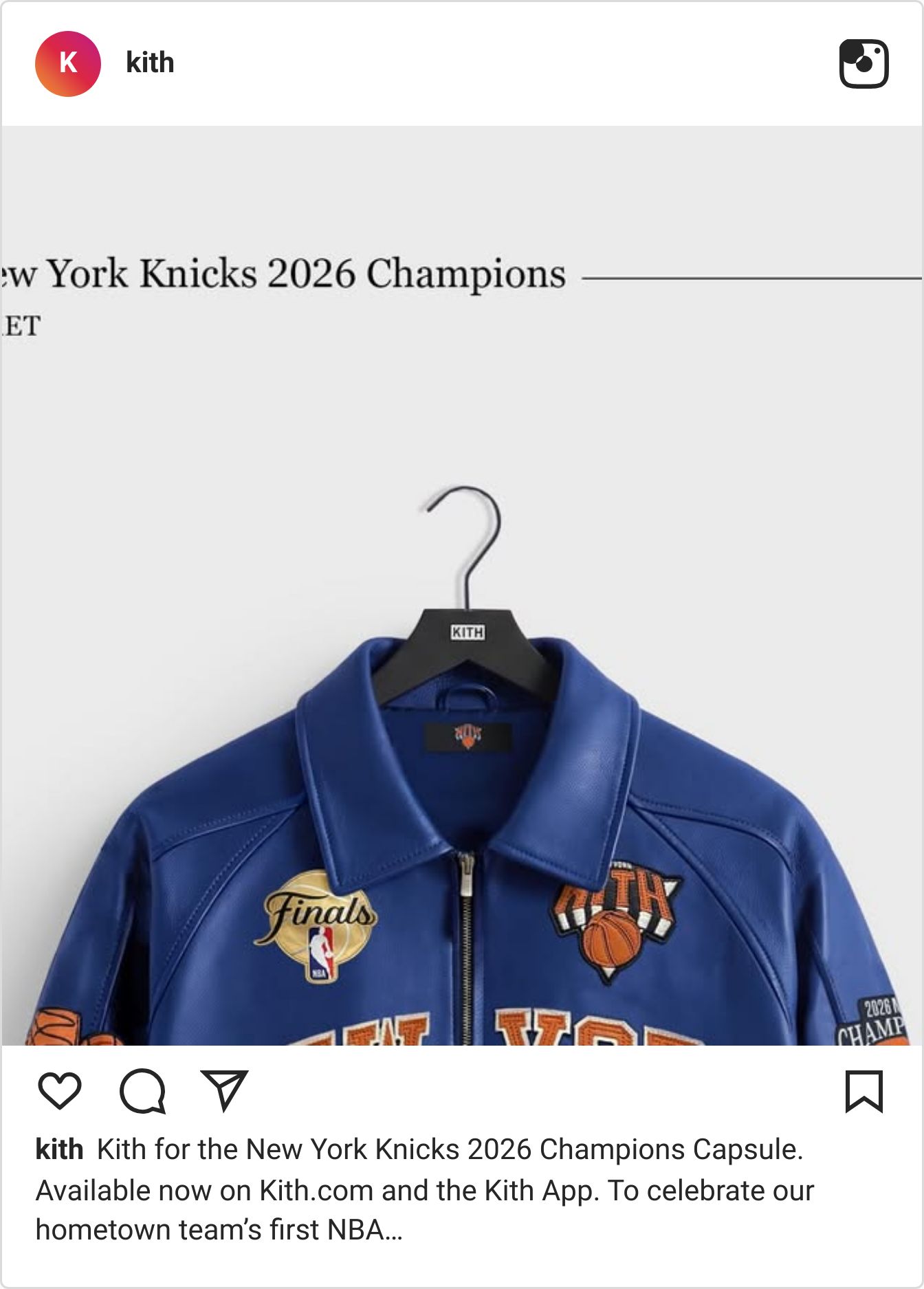
Receipt: Hypebeast
ONE LAST TAP
Forward this to the person on your team who is still running one-off influencer activations and calling it a creator strategy. The $44 billion industry being built around them has already moved on. They should too.
Tapped in. In case you aren't.
